
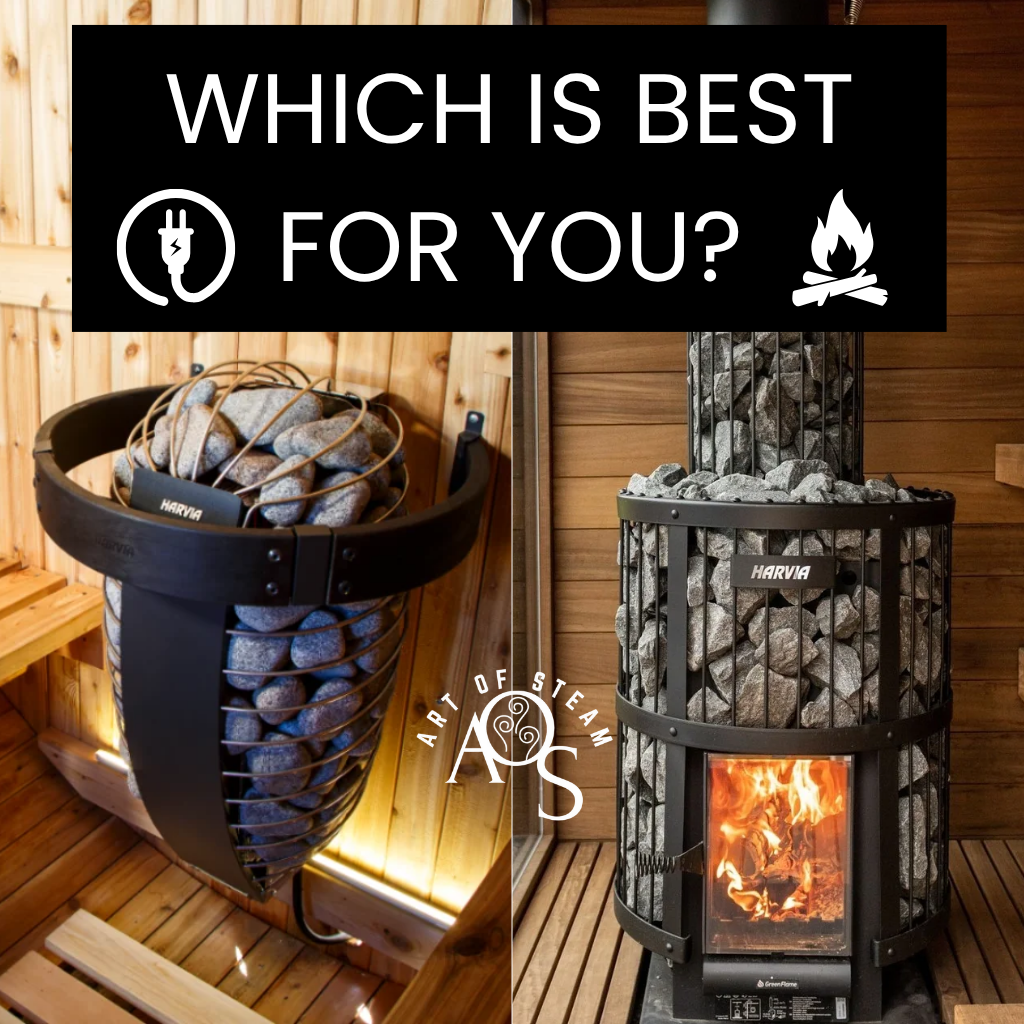
Wood-Burning vs. Electric Harvia Sauna Heaters: Which Is Right for You?
Whether you're building a backyard log sauna or designing an indoor home wellness retreat, choosing the heart of your sauna, the heater, or kiuas in Finnish, is one of the most important decisions you'll make. Here's a deep dive into wood-burning vs. electric Harvia sauna heaters, covering history, key features, installation requirements, sizing, pros and cons, and how to choose the right fit for your space.
What's Inside
Quick Answer: Wood-Burning Is Traditional and Off-Grid. Electric Is Convenient and Precise.
Choose Wood-Burning If...
- You're building an outdoor, off-grid, or cabin sauna without reliable high-amp electricity.
- You see hauling wood, stoking the fire, and waiting for the room to heat up as part of the ritual.
- You love the traditional aesthetic, firelight, and wood-smoke ambience.
- You want a built-in water tank for warm water without plumbing.
Choose Electric If...
- You're installing an indoor home sauna or have neighborhood smoke and chimney restrictions.
- You want to turn the sauna on remotely from work and step straight in when you get home.
- You prefer exact temperature precision and timer auto-shutoffs for peace of mind.
- You'd rather skip cleaning out ash, storing firewood, or installing a roof flue.
A Brief History of Sauna Heating
To understand today's heater choices, it helps to know how we got here.
The Wood-Fired Roots
For thousands of years, saunas were strictly wood-fired. The earliest Finnish saunas were earth pits or wooden huts heated by a wood fire over a pile of rocks, known as a savusauna, or smoke sauna. The fire burned for hours, smoke was vented out, and bathers enjoyed the residual heat stored in the massive stone pile. In the 20th century, chimney-vented wood stoves were invented, letting people burn wood continuously while bathing. Tapani Harvia, the founder of the Harvia brand, built his first wood-burning sauna stove in 1950, laying the groundwork for modern sauna culture.

Tapani Harvia's first wood-burning sauna stove, built in 1950.
The Electric Revolution
In the mid-20th century, urbanization and indoor home saunas drove the need for a smokeless, chimney-free alternative. Harvia and other Nordic manufacturers pioneered electric heaters using metal heating elements encased in sauna stones. This allowed urban apartment dwellers and suburban homeowners to enjoy authentic löyly, the burst of steam created when splashing water on hot rocks, with the flip of a switch.

An early Harvia electric sauna heater from 1987.
Wood-Burning Stoves: Key Features & Options
A wood-burning stove, such as the Harvia M3, 20 Pro, or Legend series, brings an irreplaceable, sensory richness to the sauna. The scent of crackling timber, the gentle glow of flames behind cast-iron glass doors, and deep radiant heat make it a traditionalist's favorite way to sauna.
Key Upgrades & Options for Wood Stoves
- External feed (through-the-wall): Standard wood stoves are stoked from inside the sauna room. Harvia's SL (external feed) models, like the Harvia Legend SL, let you load firewood from an adjacent dressing room or outside wall instead. This keeps ash, bark, and wood debris out of your clean sauna room and saves interior floor space.
- Integrated & pipe water tanks: Off-grid or outdoor saunas often lack hot running water. Harvia offers stoves with built-in water containers, like the Harvia 20 ES Pro, or chimney-pipe water heaters mounted onto the chimney pipe. The stove heats the water while simultaneously heating the room, giving you warm water for washing up without any electricity.
- Grid independence: Wood stoves operate entirely on combustion and natural draft, requiring zero electrical hookups or power grid access.

Electric Heaters: Key Features & Tech
Electric heaters, such as the compact Harvia KIP, the rock-tower Cilindro, or the stylish Spirit, offer unmatched convenience and precise control.
- Kilowatt (kW) power: An electric heater's kW rating measures its capacity to maintain heat within a specific volume of space, not how hot it gets. All Harvia residential heaters are built to reach standard sauna temperatures (160°F to 195°F). A higher kW heater than your room requires won't make the sauna hotter or heat up significantly faster, it simply means the heater is sized for a larger or more demanding space. Matching kW to your room size keeps the unit running efficiently without unnecessary electrical demand or rapid cycling.
-
Voltage (240V vs. 208V):
- 240V (residential, hardwired single-phase): Virtually all residential home saunas require a dedicated 240V line, similar to an electric dryer or oven. Standard home sizing ranges from roughly 3.5 kW up to 15 kW.
- 208V (commercial, three-phase): Commercial installations such as gyms, spas, hotels, or multi-family residential complexes typically run on 208V power. Harvia manufactures commercial-grade heaters specifically designed and element-rated for 208V systems to ensure reliable performance in commercial environments.
- Smart controllers & Wi-Fi: Modern Harvia electric heaters pair with digital control panels like the Harvia Xenio or Fenix. You can turn on your sauna from your smartphone while commuting home or set timers so it's hot the moment you're ready to start your session.

Installation Requirements & Considerations
Installing each type of heater involves completely different structural, legal, and utility requirements.
Wood-Burning Stove Installation
- Chimney flue & venting: Wood stoves require an insulated Class-A double-wall stainless steel chimney pipe exiting through the roof or rear wall. Proper flashing, rain caps, and roof clearance are critical to avoid leaks or fire hazards.
-
Safety clearances & fireproofing: Because wood stoves radiate intense heat from their metal bodies, Harvia strictly dictates clearance to combustibles like benches and walls. You'll need:
- A non-combustible floor protective bed (tile, stone, or a Harvia steel floor protective bedding).
- Harvia protective metal wall sheathing or heat shields if installed near wooden walls.
- Wood storage & floor space: Unlike electric heaters, which mount to the wall, wood stoves require extra floor space around the loading door. You'll need room to safely open the firebox door, clear out ashes, keep a hearth tool set nearby, and store a small supply of dry firewood away from radiant heat sources.


Electric Heater Installation
- Dedicated electrical circuit: Electric heaters cannot be plugged into standard wall outlets. They require a dedicated 240V breaker, typically 30 to 60 amps depending on kW size, run directly from your home's main panel.
- Licensed electrician required: High-voltage wiring in a wet, humid room demands professional installation. High-temperature rated wire must be routed to the heater, and most building codes require that a licensed electrician perform the final hookup and sign off on the installation.
- Sensor & controller placement: Most modern electric units require mounting a temperature sensor on the wall, about 14 inches from either side of the heater and about 14 inches down from the highest point of the sauna.
Pros & Cons Breakdown
Swipe left to view the full table.
| Feature | Wood-Burning | Electric |
|---|---|---|
| Atmosphere & scent | Unmatched natural wood aroma, crackling fire, dancing flames | Clean, quiet, minimal scent, focused purely on hot rocks |
| Heat quality | Deep, radiant heat; excellent soft steam off large rock beds | Quick, adjustable heat; pillar and cage models hold large rock capacity for soft steam |
| Convenience | Requires gathering wood, building and stoking the fire, cleaning ash | Push-button or smartphone app startup, zero physical fuel prep |
| Installation requirements | Chimney pipe flue, fireproof floor pad, wall safety shields | Dedicated 240V electrical circuit and breaker installed by an electrician |
| Location flexibility | Ideal for outdoor, rural, or off-grid setups | Ideal for indoors, suburban homes, or urban decks |
| Temperature control | Adjusted manually via intake vents and wood fuel volume | Exact digital thermostat and timer controls with proper ventilation |
How to Size Your Sauna Heater (The Formula)
Getting the heater size right ensures your sauna heats up quickly without overworking the unit. Undersized heaters take forever to reach temperature, while oversized electric units can cycle off before the stones are fully saturated with heat.
Step 1: Calculate Room Volume
Determine the raw interior space of your sauna cabin:
Length (ft) × Width (ft) × Height (ft) = Volume in Cubic Feet
Step 2: Account for Glass, Insulation, and Location
Your raw room volume is only part of the equation. Factors like large glass doors, full panoramic windows, uninsulated wood walls, concrete or tile, and outdoor climate exposure dramatically strip heat from the room and require specialized multipliers to properly upsize your heater.
Because under sizing a heater can lead to longer heat-up times and higher energy bills, getting an accurate adjusted volume is essential before choosing between a wood-burning or electric heater. Let us do the math for you.
Frequently Asked Questions
What size heater do I need for my sauna?
Heater size depends on your room's cubic footage, adjusted for glass, insulation, and wall materials, not just square footage. Use the Art of Steam sauna sizing calculator or book a free consultation and we'll match you with the right kW or wood stove size.
Do I need a chimney for a wood-burning sauna heater?
Yes. Wood-burning stoves require an insulated Class-A double-wall stainless steel chimney pipe vented through the roof or rear wall, along with proper flashing and clearance.
What voltage does an electric sauna heater need?
Most residential electric heaters require a dedicated 240V circuit, similar to an electric dryer. Commercial installations typically run on 208V three-phase power, and Harvia offers heaters specifically rated for each.
Can I get hot water from a wood-burning sauna heater?
Yes. Select Harvia wood stoves include an integrated water tank, or you can add a chimney-pipe water heater, so the stove heats water for washing up while it heats the room, with no electricity required.
Can I control a Harvia electric heater remotely?
Yes. Harvia electric heaters pair with smart controllers like the Xenio or Fenix, letting you start your sauna and set timers from your smartphone before you get home.
Do I need an electrician to install an electric sauna heater?
Yes. Electric sauna heaters require a dedicated high-voltage circuit run from your home's main panel, and most building codes require a licensed electrician to perform the final hookup and sign off on the installation.
